
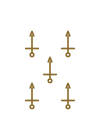
 Five of Swords
 Tarot Card Meaning
Five of Swords tarot card meaning: conflict, self-interest and a hollow victory that costs too much; reversed, lingering resentment or a chance at amends.
hollow victory · conflict · self-interest · tension after a quarrel
- Element
- Air
- Astrology
- Venus · Aquarius
- Number
- 5 — Change, crisis, movement
- Keywords
- hollow victory · conflict · self-interest · tension after a quarrel
Related astrology meaning: Venus · Aquarius
Five of Swords upright meaning
A dispute may leave someone winning on paper while everyone loses something. Ask whether being right is worth the cost to trust and goodwill. If you are on the losing side, walking away may be wiser than fighting on; if you are winning, consider what you are actually gaining.
Five of Swords reversed meaning
Resentment from a past clash may still be shaping your choices. There is a chance now to make amends, or to accept a loss and stop relitigating it. Be honest about the part you played; reconciliation, or at least a clean ending, can lighten what you carry.
Five of Swords tarot card symbolism
In the foreground a man looks over his shoulder with a faint, mocking smile. He rests two swords against his shoulder and holds a third point-down; two more lie on the ground at his feet. Behind him two figures walk away toward the water, their backs turned. One hangs his head with his face in his hands. The clouds are torn and jagged, and the whole scene feels windswept and unsettled.
The victor holds most of the blades, yet nobody is left standing beside him. That is the real question of the image: when everyone has left the field, has the one who remains actually won? In the Golden Dawn's Book T the card is titled the "Lord of Defeat." The defeat does not belong only to those walking away; the price of victory is just as much the card's subject.
Five of Swords upright meaning
The Five of Swords describes moments when winning and being right turn out to be two different things. You may have come out on top in an argument, a competition or a negotiation, but your words cut deeper than you intended, trust took a hit, and the people who left the table look unlikely to come back. Or you may be one of the departing figures, feeling outmaneuvered, unheard or treated unfairly.
The card holds up a mirror to both sides. If you are winning, weigh how much of what you gained is still worth having. If you are losing, remember that fighting every battle to the bitter end is not a matter of honor; sometimes stepping back means saving your strength for something that deserves it. Pride, stubbornness, mockery and the need to have the last word are the themes this card puts on the table. Defending your boundaries is legitimate. The trouble starts when the fight itself becomes the goal.
Five of Swords reversed meaning
Reversed, the Five often shows the dust settling after a clash. Both sides are tired, and stubbornness may be ready to give way to a calmer conversation. An apology, an attempt at mediation or a shared decision to drop the subject could be on the way.
The same position can also describe an old defeat still replaying in your mind. Reliving an injustice again and again, rehearsing revenge or regret, quietly drains your energy. Sometimes the conflict has not ended at all; it has simply gone underground, and resentment that is never spoken turns into cold distance. Seeing your own share honestly, and forgiving yourself for it, is an important part of this side of the card.
Five of Swords in love and relationships
In an established relationship this card can point to a loop that keeps circling around who is right. The same argument returns in different costumes, and each time one person wins the other withdraws a little further. Winning the argument and losing the closeness is the card's classic warning. Barbed jokes, constant reminders of old mistakes or a pointed silence make the air heavy.
After a breakup, it can show that keeping score of who "won" is delaying your grief. In new romance, watch for power games and moves designed to test the other person. Saying what you actually need, in one calm sentence, wins you far more than gathering up the swords.
Five of Swords in work and money
At work it can describe competition turning harsh: power plays within a team, favoritism, or someone taking credit for another person's effort. Humiliating a colleague to win a point in a meeting gains you a point today and an adversary for years. If your own work has been made invisible, raising it calmly and with documentation is far more effective than a public fight.
With money, the card highlights disputes in which everyone loses: inheritance quarrels, partnership breakdowns, lawsuits whose costs could swallow whatever is recovered. Before entering one, count not only your chances of winning but also the cost in time, nerves and relationships, and get qualified advice where it matters.
Five of Swords: astrology and element
The card corresponds to the first decan of Aquarius, 0–10° Aquarius, ruled by Venus. Venus seeks harmony, intimacy and sharing; Aquarius, a fixed air sign, holds tightly to its principles and values ideas over personal ties. This blend explains the card's tension: Venus, who wants to protect the bond, is weakened by fixed Air that refuses to concede the point.
The suit of Swords belongs to Air, the realm of thought, speech and decision. In every suit the five is the point where balance breaks. After the rest of the Four comes this upheaval, in which words become weapons.
Five of Swords: advice
- Before stepping into a conflict, ask honestly what you would lose if you won.
- Remind yourself of the difference between being right and being understood, and choose which one you need.
- Stop replaying a battle you lost; take one lesson from it and let the rest go.
- If you notice you said something cruel, apologize soon and without adding a justification.
Updated: October 27, 2026
Five of Swords tarot card: frequently asked questions
What does the Five of Swords tarot card mean?
The Five of Swords shows a winner collecting blades while others walk away. Upright, it warns of conflict where winning damages relationships. Ask whether being right is worth the cost. Sometimes the wiser move is to pick your battles or let a fight go.
What does the Five of Swords reversed mean?
Reversed, the Five of Swords suggests resentment from a past clash still shapes your choices. There is now an opening to make amends, or to accept a loss and stop relitigating it. Be honest about your own part; reconciliation or a clean ending lightens the load.
What does the Five of Swords mean in love?
In love, the Five of Swords points to arguments, hurtful words or a power struggle where someone always has to win. Trust may be strained. Consider whether the relationship is a partnership or a contest, and look for ways to fight fair or step back.
Is the Five of Swords a yes or no card?
The Five of Swords is generally a no. Even if you get what you want, it may come at the expense of trust or goodwill. Think carefully about whether this outcome is worth what it would cost you and others.