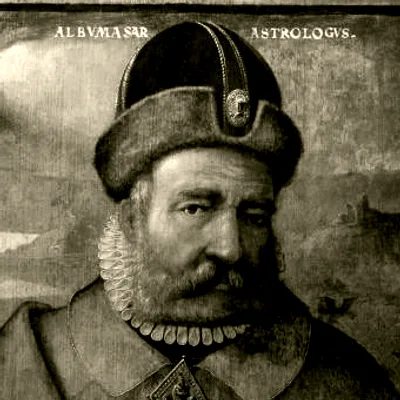
Abu Ma'sharA personal period reading with Abu Ma'shar
787–886 · Period reading · Balkh · BaghdadBorn in Balkh, he worked in Baghdad; his writings on great conjunctions, solar returns and cycles were translated into Latin as "Albumasar" and read for centuries. He sees time in cycles and answers "when" with a range, like a season.
Whose season shall we read?
From My chartsAI Astrology Forecast
Abu Ma'shar builds your birth chart in AstroSitus's own calculation engine and reads the period ahead with traditional predictive techniques: outer-planet transits, the annual profection and lord of the year, the solar return chart, secondary progressions and age cycles. Every date comes from the engine; Abu Ma'shar explains what those dates mean in a calm voice that moves like the seasons. The result is a personal reading of now, this year, the next three months and a 3-, 6- or 12-month calendar.
What is an astrology forecast?
An astrology forecast moves the birth chart forward in time to see which themes come to the fore in which period. The birth chart is the starting point; predictive techniques show how it unfolds over the years. The aim is not to announce fixed events but to understand the quality of time: which months suit building, which suit rest, and which suit new beginnings?
A short history
Most timing techniques were born in the Hellenistic period and developed in 8th- to 10th-century Baghdad, in the hands of astrologers writing in Arabic. Annual profections and the charts of the yearly return of the nativity (what we now call the solar return) are set out in detail in the books of this era; Abu Ma'shar's book on the revolutions of the years of nativities is a well-known example. Secondary progressions became widespread in the early modern period, and outer-planet transits entered astrology after the discovery of Uranus (1781), Neptune (1846) and Pluto (1930).
Four core techniques
- Transits: the planets' current positions making aspects to points in your birth chart. The slow planets (Jupiter, Saturn, Uranus, Neptune, Pluto) describe themes that last for months, and because of retrograde motion a transit often touches the same degree several times. (Tracking transits, transit meanings)
- Annual profections: on each birthday the year moves on by one sign, starting from the Ascendant, completing a cycle every 12 years. The planet ruling that year's sign becomes the "lord of the year", and its movements set the year's tone.
- Solar return: the chart for the moment each year when the Sun returns to its exact birth degree, summing up the year from one birthday to the next.
- Secondary progressions: based on the principle of "a day for a year", each day after birth corresponds to a year of life. The progressed Moon changes sign roughly every two and a half years and tracks shifts in your emotional climate.
Eclipses (the meaning of eclipses) and age cycles are added to these, such as the Saturn return around age 29–30 or the Jupiter return roughly every 12 years. Retrograde planets explain why a transit can repeat several times.
How a forecast is read
A single transit says little on its own. A reliable forecast comes from several techniques pointing to the same theme. For example, a profection to the 10th house, Saturn crossing the MC and a career emphasis in the solar return together point to a period of restructuring at work. Timing is read as a window, too: the days a transit begins, perfects and ends. To see your own transits date by date, try the transit calendar.
What it can and can't answer
A forecast helps you understand the main themes of a period, the busy and quiet months, and the times for deciding and preparing. It doesn't promise fixed events, dates or outcomes, and it makes no predictions about health, death or pregnancy. If you're looking for the best moment to start something, that's a different question, and electional astrology is the right tool. To get to know the chart itself, a birth chart reading is a good start.
How Abu Ma'shar works on AstroSitus
- 1You pick a person from My Charts and, if you like, add a focus (work, relationships, moving, education, money) or a short question, and choose a 3-, 6- or 12-month calendar.
- 2AstroSitus's engine calculates the start, exact and end dates of transits, eclipses, the profection year and lord of the year, the solar return chart, secondary progressions and age cycles.
- 3Abu Ma'shar only interprets those dates; he never invents one, and he describes the themes of the period like a season.
- 4The reading covers now, this year, the next three months and a calendar of the length you chose; you can go deeper with follow-up questions.
Who was Abu Ma'shar al-Balkhi?
Abu Ma'shar Ja'far ibn Muhammad ibn Umar al-Balkhi (787–886), known in Latin as Albumasar, was the most famous astrologer of Abbasid Baghdad. He was born on 10 August 787 in Balkh, in Khurasan (today in Afghanistan), and died on 9 March 886 in Wasit, Iraq. He probably came to Baghdad early in the reign of the caliph al-Ma'mun and lived on the city's west side, near the Khurasan Gate.
A scholar who came late to astrology
According to biographical tradition, Abu Ma'shar first worked in hadith scholarship and turned to astrology only at the age of 47. He is reported to have had a bitter dispute with the philosopher al-Kindi, a clash that led him to study mathematics. Another report says he was flogged for practising astrology under the caliph al-Musta'in (862–866), and quotes him as saying: "I hit the mark, and I was severely punished."
His works
His Kitab al-madkhal al-kabir (Great Introduction to the Science of Astrology), written around 848, is a comprehensive handbook that tries to ground astrology in Aristotelian natural philosophy. It was translated into Latin by John of Seville in 1133 and by Hermann of Carinthia in 1140, and printed in Augsburg in the late 15th century. His Kitab al-milal wa-l-duwal (Book of Religions and Dynasties), often considered his most important work, reads the history of religions and dynasties through Jupiter–Saturn conjunctions and other celestial cycles; in Latin it was known as the book on the great conjunctions (De magnis coniunctionibus). His book on the revolutions of the years of nativities explains how to read a person's yearly return charts. Abu Ma'shar also wrote about the link between the Moon and the twice-daily tides.
His influence
His Latin translations played a part in the rediscovery of Aristotle's natural philosophy in 12th-century Europe. The name Albumasar turns up again and again in writers such as Albertus Magnus, Roger Bacon, Pierre d'Ailly and Pico della Mirandola, and both defenders and critics of astrology treated him as a key authority.
AstroSitus's Abu Ma'shar is an AI advisor inspired by Abu Ma'shar's way of reading time in cycles; he is not Abu Ma'shar himself and does not speak on his behalf.
Astrology forecast FAQ
How does an AI astrology forecast work?
You pick a person from My Charts. The start, exact and end dates of transits, the profection year, the solar return and progressions are calculated by the AstroSitus engine; Abu Ma'shar only interprets those calculations and never invents dates. A reading arrives in about 30–60 seconds.
What is a solar return?
A solar return is the chart for the moment each year when the Sun returns to its exact birth degree. It sums up the themes of the year from one birthday to the next. AstroSitus calculates it for the birthplace; without a birth time, the SR rising sign and houses aren't interpreted.
What is a profection year?
Annual profection is a traditional timing technique that moves forward one sign on each birthday, starting from the Ascendant, and returns to the start every 12 years. The planet ruling that year's sign becomes the lord of the year and shows the year's main theme.
What is a transit and how long does it last?
A transit is a planet in the sky making an aspect to a point in your birth chart. Moon transits last hours and Sun or Mercury transits a few days, while Saturn, Uranus, Neptune and Pluto transits can stay active for several months to a year because of retrograde motion.
Which techniques does the forecast use?
Transits of Saturn, Jupiter, Uranus, Neptune and Pluto; Mars triggers and eclipses; the annual profection and lord of the year; the solar return; secondary progressions (especially the progressed Moon) and age cycles such as the Saturn return are weighed together.
Can I get a forecast without a birth time?
Yes. Planet-to-planet transits and age cycles work without a birth time. The Ascendant, MC, houses, SR rising sign and house ingresses need a time, so they are skipped and the reading says so clearly.
Does it predict a fixed future?
No. Abu Ma'shar reads a period like a season: which themes come forward and how time flows, never a verdict of fate. It doesn't give readings on health, death or pregnancy.
Is Abu Ma'shar a real astrologer? Is it free?
Abu Ma'shar is an AI advisor developed by AstroSitus, inspired by the approach of Abu Ma'shar al-Balkhi. It's open to free members, with a daily reading allowance and follow-up questions for each reading. Your readings are stored only in your account.
Related AI advisors
✦Abu Ma'shar is an AI advisor developed by AstroSitus, inspired by the approach of Abu Ma'shar al-Balkhi; it is not Abu Ma'shar himself. Dates are calculated by the AstroSitus engine. Readings are for entertainment and self-reflection; they don't announce a fixed future and are no substitute for your own decisions.