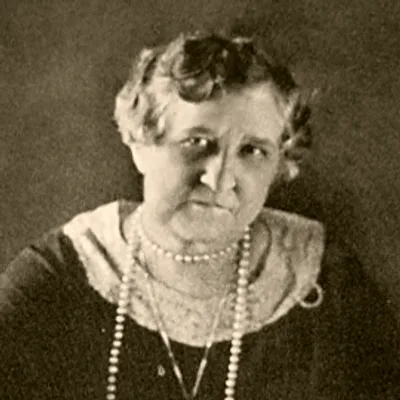
Evangeline AdamsAI synastry and composite chart reading
1868–1932 · Relationship astrology · New YorkFrom her studio at Carnegie Hall in early-1900s New York she advised bankers, artists and ordinary people, reading relationships warmly but without beating around the bush. Trained at AstroSitus in her approach, this advisor opens two charts side by side and talks you through your relationship section by section.
Whose compatibility shall we look at?
Two charts · synastry and compositeRelationship astrology with Evangeline
Synastry lays two birth charts over each other: which aspects do one person's planets make to the other's, and which houses do they fall into? It shows what two people awaken in each other: attraction, emotional security, communication and the points of friction.
The composite chart is built from the midpoints of both charts and describes the relationship itself as a third entity. Evangeline reads both together; she gives no verdicts or prophecies and stays at an equal distance from both people.
What is relationship astrology? Synastry and the composite chart
Relationship astrology reads two people's birth charts together to understand the attraction, the harmony and the likely friction between them. Sun-sign compatibility in magazines compares only two Sun signs; a real comparison takes in both whole charts, including the Moon, Venus, Mars, the Ascendant and the houses.
A short history
Comparing charts for marriage is an old idea: in the Tetrabiblos, Ptolemy ties harmony between partners to how the lights, the Sun and the Moon, relate across the two charts, and medieval astrologers also read charts side by side. Synastry in its detailed modern form, however, developed in the 20th century. The composite chart, built from the midpoints of two charts, caught on in the 1970s, and Robert Hand's Planets in Composite (1975) became one of its standard references.
Synastry: one chart laid over another
In synastry, one person's planets are placed in the other's chart and two kinds of information are read:
- Aspects between the charts: one person's Venus conjunct the other's Mars suggests strong attraction, while one person's Moon square the other's Saturn can point to emotional distance or a theme of responsibility. The orb (how tight the aspect is) and whether it is applying or separating set how strongly it is felt.
- House overlays: the houses one person's planets fall into in the other's chart show which areas of life they stir up. If your partner's Sun falls in your 7th house, they bring out the theme of partnership in you.
For the full method, read how to read synastry; for a quick score between two charts, try the love compatibility tool. The general meanings of aspects are covered in how to read aspects.
The composite chart: the relationship's own chart
A composite chart is calculated from the midpoints of each pair of planets: the midpoint of the two Suns becomes the composite Sun, the midpoint of the two Moons the composite Moon. The result belongs to neither person but to the relationship itself, so its purpose, emotional climate and challenges are read there. In short, synastry asks "what do we awaken in each other?" and the composite chart asks "what are we together?"
What astrologers look at
In long-term relationships, Sun–Moon contacts (basic compatibility), Venus–Mars aspects (attraction), Mercury contacts (communication) and Saturn contacts (commitment and testing) usually stand out. One hard aspect does not seal a relationship's fate; what counts is the sum of the themes and how two people work with them.
What it can and can't answer
Relationship astrology gives two people a language for talking about their needs, strengths and sensitive spots. Chart comparison doesn't answer yes-or-no questions such as "Will we marry?" or "Will we break up?"; for one clear question like that, horary astrology is the better tool. If you'd like to understand your own chart first, a birth chart reading is a good place to start.
How does it work?
- 1You choose two people from My charts; for someone without a birth time, houses and the Ascendant aren't interpreted.
- 2AstroSitus's engine calculates both charts, the aspects between them (with orb and applying/separating), the house overlays and the midpoint composite chart.
- 3Evangeline writes from this data only: attraction, harmony and sustainability indicators and a thorough six-section reading.
- 4You can go deeper with follow-up questions and reopen the reading any time from My questions.
Why Evangeline?
The calculation is never left to the model: AstroSitus's own engine computes every position and aspect. The reading follows rules compiled from the relationship-astrology methods of Arroyo, Greene, Hand, Sargent, Tompkins, Donath and Thornton, and describes both people without blame, in the language of mutual needs.
Who was Evangeline Adams?
Evangeline Smith Adams (1868–1932) is often called America's first celebrity astrologer. She was born on 8 February 1868 in Jersey City, New Jersey; her father died when she was a baby. Around the turn of the century she settled in New York, where she built a large consulting practice, seeing clients in person and by mail, with a staff of assistants and stenographers.
The Windsor Hotel story
By her own account, Adams foresaw the fire that destroyed New York's Windsor Hotel in 1899. The story helped make her name, but it rests on her own telling and has not been independently confirmed.
On trial
Fortune-telling was illegal in New York at the time, and Adams was arrested on those grounds in 1911, 1914 and 1923; none of the prosecutions succeeded. The best-known case came in May 1914. As the story goes, the judge gave her only the birth data of his son and asked for a reading, was impressed by what she said and acquitted her, remarking in a decision quoted by the newspapers that she had raised astrology "to the dignity of an exact science". The ruling did not legalise astrology, but it put the difference between an astrologer and a fortune-teller before the public.
Books, radio and Crowley
Adams published her autobiography, The Bowl of Heaven, in 1926, followed by Astrology: Your Place in the Sun (1927) and Astrology: Your Place Among the Stars (1930). Her 1930–31 radio programme is remembered as one of the most popular of its day. The occultist Aleister Crowley worked for a time as a ghostwriter on her books; the partnership later soured into a copyright dispute. Critics still point to her comments before the 1929 crash that stocks would keep climbing. She married George Edwin Jordan in 1923, and one newspaper of the day reported that she had picked even the wedding date by the stars. She died on 10 November 1932.
AstroSitus's Evangeline is an AI advisor inspired by Evangeline Adams's warm, direct consulting style; she is not Adams herself and does not speak on her behalf.
Synastry and composite chart FAQ
What is synastry?
Synastry is the method of comparing two birth charts by laying one over the other. Astrologers look at the aspects one person's planets make to the other's and which houses they fall into, which shows attraction, emotional harmony, communication and points of friction.
What is a composite chart and how is it calculated?
A composite chart is a single chart built from the midpoints of each pair of planets in two charts: the midpoint of the two Suns becomes the composite Sun. It describes the relationship as a third entity. AstroSitus calculates it with the midpoint method.
Is Sun-sign compatibility the same as synastry?
No. Sun-sign compatibility usually compares only two Sun signs. Synastry looks at both whole charts: the Moon, Venus, Mars, the Ascendant, the houses and every aspect between them. Two couples with the same Sun signs can have very different synastry.
Which aspects matter most in synastry?
Traditionally, Sun–Moon contacts (basic compatibility), Venus–Mars aspects (attraction), Mercury contacts (communication) and Saturn contacts (commitment and testing) carry the most weight. Tight orbs are more noticeable, and repeated themes matter more than any single aspect.
What's the difference between synastry and a composite chart?
Synastry shows how two people affect each other; the composite chart shows the shared structure they create together. Evangeline reads both.
What if I don't know the birth time?
The signs of the planets and the aspects between them are still read; that person's Ascendant, houses and the composite houses aren't interpreted. Evangeline says so in the reading.
Is it free?
Free for members: a set number of readings each day and follow-up questions for each reading. Membership is required because the people are chosen from My charts.
Will Evangeline answer "will we break up?"
No. Chart comparison is guidance, not prophecy; it doesn't predict permanence or a break-up. Health, pregnancy and violence aren't interpreted either.
Related AI advisors
✦Evangeline is an AI advisor developed by AstroSitus and inspired by Evangeline Adams's approach; she is not Evangeline Adams herself. AstroSitus's engine calculates the charts. Readings are for entertainment and self-reflection and don't replace your own decisions about your relationship.