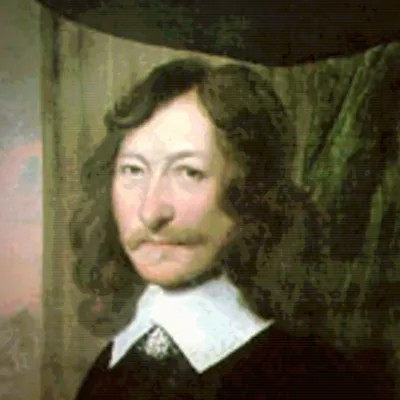
William LillyAI Astrologer for horary astrology
1602–1681 · Horary astrology · LondonWith Christian Astrology (1647), William Lilly set the rules of horary astrology for more than three centuries; he was questioned before Parliament for having foreseen the Great Fire of London years earlier. Trained at AstroSitus on the method of his book, he is now waiting for your question.
What is horary astrology?
Horary astrology looks for the answer to a question in the chart of the moment the question is asked. No birth chart is needed: the question is born with its own chart. The Ascendant stands for the person asking, the relevant house for the person or matter asked about, and the aspects between them give the answer.
The most widely read master of this method is William Lilly. His Christian Astrology, written in 1647, has been the textbook of horary for more than three centuries. AstroSitus's AI Astrologer was trained on the rules of this book: ask the AI your astrology question and Lilly answers instantly, in his own voice.
Horary astrology: a short history, good questions and limits
The birth moment of a question
Horary astrology (from the Latin hora, "hour") treats the moment a question becomes clear in your mind as the question's own birth. In that chart the Ascendant and its ruler stand for you, the house of the matter and its ruler stand for the person or thing you are asking about, and the Moon is a co-significator that carries the flow of events. If the two significators are moving toward an aspect that perfects, the matter comes about; if the aspect is blocked or absent, it doesn't. For a step-by-step introduction, read horary astrology basics.
A short history
Reading a chart for a question grew out of the inceptional (katarche) astrology of the Hellenistic world and became a branch of its own in the 8th and 9th centuries, in the hands of Arabic-language astrologers such as Masha'allah and Sahl ibn Bishr. In the 13th century Guido Bonatti gathered these rules in Latin. William Lilly's Christian Astrology (1647) was the first major book to teach the method in English, with worked examples. Traditional horary had a revival in the late 20th century, when Lilly's book came back into print.
Which questions work best?
Horary works best with one clear question that genuinely matters to you: "Will I get this job?", "Is the key I lost somewhere in the house?", "Will I sell this flat?" Broad questions ("How will my life turn out?") belong to birth chart reading, which is what Ptolemy is for. Choosing the best moment to begin something isn't horary either; that is electional astrology, and Bonatti scans a date range to find it.
An example
For "Will I get the job I applied for?", the ruler of the Ascendant shows you and the ruler of the 10th house shows the job. Say Aries is rising, so Mars is your significator, and the 10th house is Capricorn, ruled by Saturn. If Mars is applying to a trine with Saturn before either changes sign and no other planet gets in the way, the answer is an easy yes; a square still says yes, but with delay and effort. If Mars turns retrograde before the aspect perfects, the matter can fall through at the last moment.
What it won't answer
Horary is not a fortune-telling machine. When the chart carries warnings that it isn't fit to be judged, or when there is no clear link between the significators, the honest answer is "uncertain". A void-of-course Moon also suggests a weak outcome; see the void-of-course Moon explained. Questions about health, death and similar sensitive matters are not answered, and horary never replaces professional advice.
What can you ask Lilly?
Any single, clear question that can be answered yes or no:
- Relationships: Will my ex come back? Will this relationship lead to marriage?
- Work: Will I get the job I applied for? Will I be promoted?
- Money: Will my debt be repaid? Will this investment pay off?
- Home and moving: Will I sell this house? Should I move?
- Lost items: Will I find the ring I lost, and where is it?
- Travel and visas: Will my visa be approved? Will this trip happen?
- Education: Will I pass the exam? Will I be accepted to the school?
- Lawsuits and disputes: Will I win the case? Will we reach an agreement?
How is Lilly's judgment born?
- 1The sky is recorded the moment you ask: AstroSitus's precision engine casts the chart of that moment in seconds.
- 2Lilly reads it with his own method, the one that has guided horary astrology for over three centuries, and finds the signs at the heart of your question.
- 3AstroSitus's AI completes in seconds a study that would take a master hours; no detail slips through.
- 4Then the judgment arrives: clear, reasoned and in Lilly's own voice. History's most famous horary astrologer is now at the table for you.
Why AI horary astrology at AstroSitus?
In horary, one degree can change the answer. That's why we never let the AI calculate the chart: AstroSitus's own engine settles in seconds when aspects will perfect, whether another planet gets in the way and whether the Moon is void of course. Lilly only interprets; the reasons for the judgment are always in the chart summary.
Horary as a craft of rules
Horary is the most rule-bound branch of astrology. A natal chart is read for character and tendencies over a lifetime; a horary chart is read for one matter only, and its judgement rests on a fairly small set of testable conditions. Does the planet that signifies you meet the planet that signifies the thing you want? Does anything get in the way first? Is the chart fit to be judged at all? William Lilly's Christian Astrology set these conditions out in English in 1647 with worked examples, and that procedure is what this page follows.
Because the method is so specific, it rewards questions that are specific too. A question about one person, one object or one decision fits the chart; a question about your life in general does not have a house to live in.
What the engine works out before Lilly speaks
When you ask, the site casts the chart for the moment and the place you choose, using Regiomontanus houses, the system Lilly himself used. At extreme latitudes where Regiomontanus cannot be calculated, it falls back to Porphyry houses. Only the seven traditional planets, Sun to Saturn, are used, as in Lilly's day. The engine then determines:
- whether it is a day or night chart and which planet rules the planetary hour;
- for each planet: sign, degree, house, retrograde motion, speed compared with its average, essential dignities (domicile, exaltation, triplicity, term, face) and debilities (detriment, fall), whether it is combust (within 8°30' of the Sun in the same sign), cazimi, under the Sun's beams or besieged between Mars and Saturn;
- the significators: the ruler of the Ascendant and the Moon for you; for the matter, the ruler of the house matching the category you chose, such as the 7th for relationships, the 10th for work or the 4th for moving, plus natural significators;
- every Ptolemaic aspect (conjunction, sextile, square, trine, opposition), whether it is applying or separating, and whether it perfects before either planet leaves its sign;
- reception between the significators, translation and collection of light;
- impediments: refranation, when one planet turns retrograde before the aspect perfects, and prohibition or frustration, when a third planet completes an aspect with one of them first;
- the Moon's last aspect, its next aspect and every aspect left before it changes sign, plus whether it is void of course or in the via combusta.
The AI does not calculate any of this. It receives the finished data and interprets it.
How a judgement is read
The heart of a horary answer is perfection. In Lilly's terms, a matter comes to pass when the significators come together by an applying aspect, or when another planet joins them. A trine or sextile brings it about easily, a square with effort and delay, an opposition with conflict or regret. Translation of light happens when a faster planet separates from one significator and applies to the other, carrying the connection; collection happens when a slower planet receives applying aspects from both. A separating aspect describes what has already happened, not what will.
Reception shapes the quality of the outcome: a significator placed in the dignities of the other shows interest or willingness, and mutual reception can soften even a hard aspect. Dignity, house and speed describe how capable each party is.
Lilly also listed considerations before judgement, warnings that the chart may be unreliable. The site flags those it can check: an Ascendant in its first 3° (too early) or last 3° (too late), Saturn in the 1st or 7th house, a void-of-course Moon, the Moon in the via combusta or in the last degrees of a sign, a combust Ascendant ruler, and a planetary hour ruler that does not agree with the Ascendant. These flags lower confidence; they do not reverse the answer by themselves.
Frequently asked questions
Why does the site use Regiomontanus houses for horary?
Lilly and most 17th-century English astrologers used Regiomontanus, and the house positions of the significators change the reading, so the site follows his system. Your birth chart elsewhere on the site uses Placidus by default, which is why a planet may sit in a different house in the two charts.
What happens if the Moon is void of course in my chart?
Lilly treated a void Moon as a sign that the matter tends not to move forward. The site counts the Moon as void when it makes no further aspect before leaving its sign, and also, following a stricter modern convention, when it must travel 15° or more to its first aspect. The answer is still given, with lower confidence.
Why are Uranus, Neptune and Pluto missing?
Horary rules were developed for the seven visible planets, and dignities, receptions and planetary hours only exist for them. Adding the outer planets would mean judging by rules that were never written for them.
What does an "unclear" verdict mean?
It means the chart does not show perfection clearly enough to say yes or no, for example because the aspect does not complete within the sign or an impediment interferes. It is an honest result, not an error; the Moon's next aspect usually shows what is likely to develop next.
Who was William Lilly?
William Lilly (1602–1681) was the best-known English astrologer of the 17th century. He was born on 1 May 1602 (Old Style) in the village of Diseworth, Leicestershire, to a farming family. He attended the grammar school at Ashby-de-la-Zouch, but with no money for Cambridge he went to London and entered the service of Gilbert Wright on the Strand. When Wright died in 1627, Lilly married his widow, Ellen; after her death a few years later, the estate she left gave him the leisure to study astrology, which he took up in 1632.
An almanac-maker in the Civil War
During the English Civil War, Lilly published prophetic pamphlets and annual almanacs that leaned toward the Parliamentarian side. His almanacs appeared every year from 1647 to 1682 and by the late 1650s were selling around 30,000 copies a year. He was close to leading figures such as Bulstrode Whitelocke and Elias Ashmole, and his political predictions landed him in court more than once.
Christian Astrology
Published in 1647, Christian Astrology was the first major astrological textbook written in English rather than Latin. Its first book covers the basics, the second teaches horary astrology through worked examples, and the third deals with birth charts. Many of its examples come from questions his own clients brought him. It is still read today as the core textbook of horary.
The Great Fire and later years
In Monarchy or No Monarchy (1651), Lilly had printed symbolic pictures of a city in flames surrounded by coffins. After the Great Fire of London in 1666, those images brought him before the parliamentary committee investigating the fire, where he was questioned. After the Restoration he retired to Hersham in Surrey, practised medicine in his last years and died there on 9 June 1681. He told his own story in an autobiography written at the request of his friend Elias Ashmole. The astrologer Sidrophel in Samuel Butler's satirical poem Hudibras is thought to be a portrait of him, and in 2003 a plaque was put up on the Strand, near where he lived from 1627 to 1665.
AstroSitus's Lilly is an AI advisor inspired by the method of William Lilly's Christian Astrology; he is not Lilly himself and does not speak on his behalf.
Horary astrology FAQ
What is horary astrology?
Horary astrology is the traditional branch of astrology that answers a question from the chart of the moment it is asked. No birth data is needed: the Ascendant stands for the person asking, the relevant house for the matter, and the aspects between their rulers give the answer.
How do you read a horary chart?
First you check whether the chart is fit to be judged. Then you find the querent's significators (the Ascendant ruler and the Moon) and the significator of the matter. An applying aspect that perfects before either planet changes sign, or a translation of light, usually means yes; an obstruction or no connection means no or uncertain.
Do I need my birth time to ask the AI astrologer a horary question?
No. Horary uses the chart of the moment the question is asked; no birth data is needed. You only choose the place where you are asking.
At what moment should I ask?
In horary, the moment is when the question became clear in your mind; usually now. You can also choose another moment.
Can I ask the same question again?
By tradition, the same question isn't asked again soon. AstroSitus also shows the earlier answer if you ask the same question within 24 hours.
Does Lilly give timing?
If the outcome is positive and the chart allows, yes: he gives a range in days, weeks or months based on the degrees left until the aspect perfects. He doesn't give exact dates.
Does Lilly answer health questions?
No. Questions about health, death and similar sensitive topics are not answered and don't use up your questions; please consult a professional.
How many questions can I ask?
Free members can ask each advisor 3 questions a day and 3 follow-up questions per answer. Questions reset every night at 00:00 (Istanbul time).
Related AI advisors
✦AI advisors inspired by historical masters. The readings follow the masters' methods and are not their own words; they are no substitute for expert advice on health, legal or money decisions.