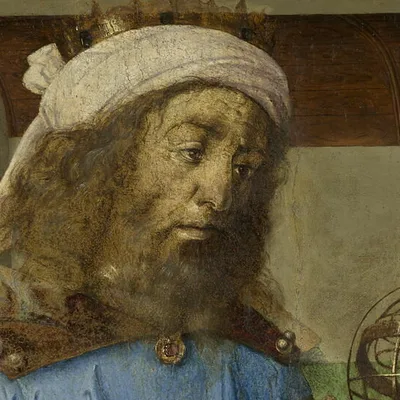
PtolemyA personal natal reading with Ptolemy
AD 100–170 · Birth chart reading · AlexandriaAstronomer of Alexandria; he set the sky into tables and gave astrology a four-book order (the Tetrabiblos). He looks at the lights first, then follows the rulers; he reads the soul from Mercury and the Moon, and action from Mercury, Venus and Mars.
Whose chart shall I read?
From My Charts · all nine sections when the birth time is knownAI Birth Chart Reading
Ptolemy builds your birth chart with AstroSitus's own calculation engine and reads it in the order of the Tetrabiblos tradition: first the day/night chart and the lights, then the chart ruler, dignities, element balance, aspects and patterns. The result is a nine-part personal reading: chart overview, the big three, love and relationships, career and money, strengths and challenges, emotional world, notable features, this year and a full listing.
What is a birth chart (natal astrology)?
A birth chart is a snapshot of the sky as seen from the place and moment you were born. It brings together the signs and houses of the Sun, Moon and planets, the aspects they make to one another, and the degree rising on the eastern horizon at birth (the Ascendant). Natal astrology reads this picture not as a ledger of fate but as a symbolic language for your tendencies, needs and life themes. To see your own chart for free, use the birth chart calculator.
A short history
Reading individual birth charts took shape in Hellenistic Egypt in the last centuries BCE, where Babylonian sky-watching met Greek philosophy; the twelve houses, the Ascendant and the strength of planets in signs all date from this period. In the 2nd century CE, Claudius Ptolemy of Alexandria organised this tradition into a systematic book, the Tetrabiblos, which through Arabic and Latin translations remained a core astrological text for well over a thousand years. In the 20th century, psychological astrology shifted the focus toward character and personal growth.
The building blocks
- Planets describe what is at work: the Sun your identity and vitality, the Moon your emotional needs, Mercury how you think, Venus love and values, Mars drive and conflict, Jupiter growth, Saturn limits and responsibility. (Planets guide)
- Signs show the tone in which each function expresses itself. (Signs guide)
- Houses say which area of life it plays out in: self, money, relationships, career and so on. (Houses guide)
- Aspects show how planets support or challenge one another. (How to read aspects)
- The Ascendant and chart ruler are the doorway to the chart, describing how you meet the world. (Your rising sign explained)
How do you interpret a birth chart?
A good reading doesn't just list the parts; it finds where the weight lies. In the traditional order you first look at whether the chart is a day or night chart (sect) and at the lights, the Sun and the Moon. Then come the ruler of the Ascendant, the planets' essential dignities (domicile, exaltation, detriment, fall), the balance of elements and modes, tight aspects, and patterns such as a grand trine or T-square. A theme that repeats is more reliable than any single factor: if Venus is strong, the 7th house is emphasised and the Moon and Venus are in harmonious aspect, relationships sit at the centre of the chart. The "big three" of Sun, Moon and Rising is often the quickest way in; if you don't know yours, try the Moon sign calculator and the rising sign calculator.
Why does the birth time matter?
Planets rarely change sign within a day, but the Ascendant changes sign roughly every two hours and the houses depend entirely on the birth time. Without a time, the planets, signs and aspects can still be read; only the house-based parts are left out. See unknown birth time? for details.
What it can and can't answer
A birth chart helps you reflect on your temperament, your leanings in love and work, your strengths and the themes you find hard. A question like "Why am I always drawn to the same kind of person?" is where chart reading shines: the answer is not a prophecy but a mirror for self-understanding. To see what a given period activates, use the transit calendar or the astrology forecast advisor. A chart does not rule on health, lifespan or fixed events, and it never replaces your own choices.
How Ptolemy works on AstroSitus
- 1You pick a person from My Charts; the birth date, time and place come from that record.
- 2AstroSitus's own calculation engine works out the planets, Placidus houses, aspects, essential dignities, element balance and patterns; the AI never guesses a position.
- 3Ptolemy reads that calculation in the order of the Tetrabiblos: day or night chart and the lights, the chart ruler, then aspects and recurring themes; this year's theme comes from the profection and slow-planet transits.
- 4Your nine-part personal reading arrives in about 30–60 seconds; you can go deeper with follow-up questions and reopen it any time from My questions.
Who was Claudius Ptolemy?
Claudius Ptolemy (Greek Klaudios Ptolemaios; c. 100 – 160s/170s CE) was an astronomer, mathematician, geographer and astrologer who lived in Alexandria in Roman Egypt and wrote in Greek. His birthplace and exact dates are unknown; the name Claudius suggests he may have been a Roman citizen. Almost everything we know about his life comes from his own works.
His works
Ptolemy's most famous book is the Almagest (originally the Mathēmatikē Syntaxis), which set out a mathematical model of the Earth-centred universe and remained the standard astronomy text in both the Islamic world and Europe until Copernicus. He also wrote the Geography, the Harmonics and the Optics. His astrological work, the Tetrabiblos ("Four Books", Latin Quadripartitum), was written after the Almagest, late in his life. In its opening, Ptolemy separates astronomy, which calculates the movements of the heavens, from astrology, which interprets their effects on Earth, and openly admits that the second cannot be as certain as the first.
His contribution to astrology
The first two books of the Tetrabiblos cover general principles and mundane astrology, dealing with countries, eclipses and weather; the last two deal with the individual birth chart: temperament, profession, marriage, wealth and the stages of life. Ptolemy did not invent these techniques. He gathered and organised the tradition and tried to explain it through the Aristotelian natural philosophy of his day, describing planetary effects as heating, cooling, moistening and drying, and setting aside practices for which no plausible account could be given. That measured, systematic approach helped astrology be treated as a subject worth debating in the Middle Ages.
His influence
The Tetrabiblos was translated into Arabic, and in 1138 Plato of Tivoli rendered it from Arabic into Latin. Read alongside the commentary of Ali ibn Ridwan (Haly), it was taught in European universities into the 17th century. The Centiloquium ("Hundred Sayings"), attributed to Ptolemy in the Middle Ages, is no longer considered his work.
AstroSitus's Ptolemy is an AI advisor inspired by Ptolemy's measured method; he is not Ptolemy himself and does not speak on his behalf.
Birth chart reading FAQ
How do you interpret a birth chart?
Start with the big three (Sun, Moon and Rising) and the chart ruler. Then combine the planets' strength in their signs, their houses, tight aspects and recurring themes. Themes that several factors agree on count for more than any single placement.
How does an AI birth chart reading work?
You pick a person from My Charts. Planet positions, houses, aspects and dignities are calculated by the AstroSitus engine; Ptolemy only interprets that calculation and never guesses positions. The reading arrives in nine sections in about 30–60 seconds.
Can I get a reading without a birth time?
Yes. Planet signs and the aspects between them are interpreted; the Ascendant, houses and house rulers cannot be calculated without a time, so those parts are skipped and the reading says so.
What is the big three (Sun, Moon and Rising)?
Your Sun sign describes your core identity and direction, your Moon sign your emotional needs and what makes you feel safe, and your Rising sign how you approach the world and the first impression you make. Together they are the quickest summary of a chart; the Rising sign needs a birth time.
Which house system is used?
Birth chart readings use Placidus, AstroSitus's default house system. Other house systems can move some planets into a neighbouring house; signs and aspects are not affected by the house system.
What does the reading cover, and what not?
It covers character tendencies, relationship and career inclinations, strengths and challenges, and the general theme of the year. It does not read on health, lifespan or pregnancy, and it never gives fixed verdicts of fate.
Is Ptolemy a real astrologer?
No. Ptolemy is an AI advisor inspired by Claudius Ptolemy's method and developed by AstroSitus. The AstroSitus engine does the calculation; readings are meant for self-reflection.
Is it free?
Ptolemy is open to free members, with a daily reading allowance and follow-up questions on each reading. Your readings are stored only in your account.
Related AI advisors
✦Ptolemy is an AI advisor inspired by the approach of Claudius Ptolemy and developed by AstroSitus; it is not Ptolemy himself. The chart is calculated by the AstroSitus engine. Readings are for entertainment and self-reflection and do not replace decisions about your life.